
.png)




General
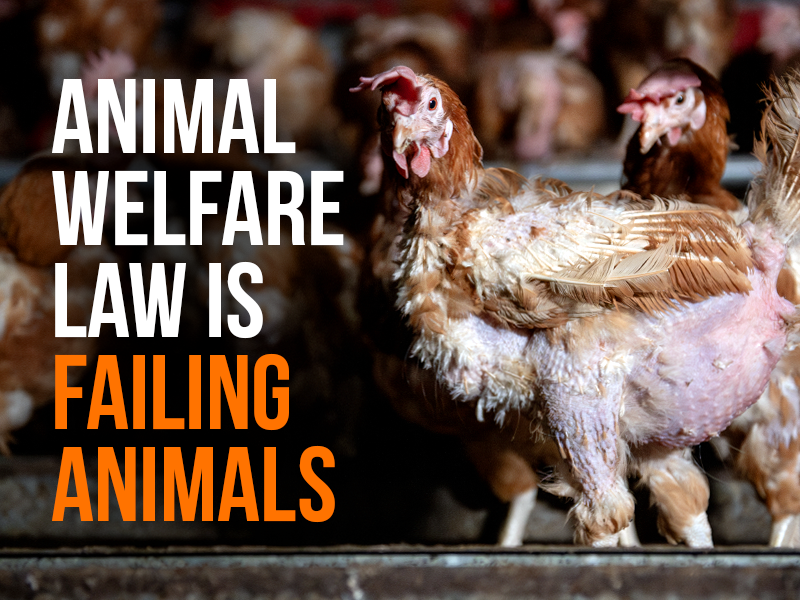
Animal Welfare Law is Failing Animals
Blog written by Julie Hurst, volunteer blog writer
“An elaborate facade.” That’s how solicitor and Animal Law Foundation founder Edie Bowles describes the UK’s animal welfare legislation. Despite having one of the world’s most extensive legal frameworks, she explains that protection for animals who are farmed in this country is essentially an empty promise, as while laws exist on paper, parliament lacks the capacity, or inclination, to enforce them.
However, it is not only the absence of an effective enforcement system that is failing the 1.3 billion animals who are killed for food each year, it is the legislation itself. Firstly, the legal standards set down are basic minimum requirements, rather than comprehensive and meaningful protection measures, though even these would not ‘protect’ animals who are being exploited and destined for slaughter. And secondly, these standards are being used to sustain a farming system in which suffering is inherent and mistreatment a matter of routine.
A DUTY OF CARE
The UK was the first country in the world to introduce a piece of animal welfare legislation – back in 1822 – and successive governments have banned a number of particularly cruel practices, including the use of gestation crates for pigs, barren battery cages for hens, hot branding of cows and the mulesing of sheep. But the introduction of the Animal Welfare Act 2006 represented a significant milestone, in that it marked a shift for the first time towards a more proactive approach to animal welfare, by imposing a duty of care.
Under the Act, those keeping animals are responsible for ensuring their needs are met. This includes providing a suitable environment and a suitable diet, ensuring animals are allowed to exhibit normal behaviours, and allowing them to be housed with, or apart from, other animals. It also requires animals to be protected from pain, suffering, injury and disease, and makes it an offence to cause any ‘unnecessary suffering’.
But despite introducing the landmark duty of care requirement for keepers of animals, there is no similar legislated duty on local authorities to enforce the provisions of the Act. And so in an era of shrinking budgets, rising costs of prosecution, and acute staffing shortages, the decision not to pursue animal welfare cases is, as Edie Bowles notes, hardly surprising. But this glaring omission is failing animals – the very beings the Act is supposed to protect – and fooling the public who quite rightly expect proper systems to be in place.
THE ENFORCEMENT PROBLEM
Whilst they have the power to act, but no duty, enforcement by authorities is effectively discretionary. As a result, associated data collected by The Animal Law Foundation paints a woeful picture. According to its latest report, only 2.2% of farms were inspected in 2024. And while over a quarter of those inspections identified breaches of animal protection law, just 2.2% of confirmed non-compliance on farms resulted in prosecution. But most troubling of all was that more than half of local authorities took no formal enforcement action whatsoever, even when they identified clear breaches.
This most recent report sets out information collected by the organisation for the third consecutive year, and as it notes, it is the third year in which the situation has not improved. However, even with a robust system of enforcement and accountability in place, there are other factors at play which compound and indeed facilitate ineffective animal protection.
Firstly, while animals can be treated as evidence in legal proceedings, their status as living property often creates additional and unique barriers to enforcement – they continue to be regarded principally as economic units. And secondly, animals cannot report crimes or provide testimony. But perhaps of most significance is the fact that animals bred for food today are almost all farmed behind closed doors – 90% of pigs and 95% of chickens are kept housed within intensive systems according to a recent World Animal Protection report. We are therefore shielded from the industry’s every day operations, and with help from vested interests, its players ensure we remain uninformed at best and misinformed at worst about the horrific realities of animal agriculture and its impacts.
THE HIDDEN REALITIES OF UK FARMING
Animals who are farmed are confined within a system driven by cost, not compassion, and kept in conditions which Compassion in World Farming (CIWF) chief executive, Philip Lymbery, has described as “utter depravation”. While the industry claims that the treatment of animals in the UK and the conditions in which they are kept are beyond reproach, intensive farming is the single biggest cause of animal cruelty on the planet, subjecting millions of innocent sentient beings to appalling treatment, with what appears to be complete impunity.
Animals on farms are treated as agricultural machines, and every aspect of their lives is controlled. They are born, fed, watered and inseminated en masse for the sole purpose of ‘protein production’. Hundreds of thousands of animals are kept in barren, caged or crowded conditions, without access to pasture, and often lacking access to fresh air and natural light to satisfy the demand for food. These unspeakable conditions cause the animals untold stress, and coupled with the fact that they are genetically bred for ‘performance’ (to grow inordinately quickly for example), they suffer from a plethora of health conditions.
Poor welfare, however, isn’t just associated with physical suffering – under the Animal Welfare Act “suffering” can mean physical or mental suffering – it also concerns preventing the experience of pleasure. Psychological wellbeing is more than the absence of distress, it is a positive state of mental satisfaction. Animals, such as pigs and chickens, are thinking and feeling creatures with not only basic physical needs but emotional and social needs too. However, given that they are bred to be killed and profit from, unsurprisingly these life essentials are completely ignored.
A CULTURE OF CRUELTY
Our hours of undercover footage show farm workers treating animals with complete disdain. They are trodden on, beaten, thrown, kicked, stamped on, and crushed by trolleys and trucks as a matter of routine. And lame and dying animals are also regularly left to suffer for hours, days, or even weeks on end. We have witnessed pigs being goaded and shocked with electric prods, a mother pig being stabbed in the head and face with a metal spade, and live birds being dropped into buckets of workers’ urine.
Although the Animal Welfare Act does not use the words ‘cruel’ or ‘cruelty’, it is an offence under the Act to cause a protected animal to suffer, and for a person to cause “unnecessary suffering” when they are responsible for an animal and fail to take reasonable steps to prevent another person from causing unnecessary suffering to the animal through their act or failure to act. Despite this, wanton abuse, which can only be described as cruel, is clearly prevalent across the industry, compounding the everyday horrors that are inherent within it.
LEGALISED EXPLOITATION
Polling consistently shows overwhelming public support for strong animal welfare protections. However, it is evident that the legal system isn’t simply failing animals who are farmed, it is actively facilitating their exploitation which, in the absence of adequate authority action, continues to be exposed by undercover investigations.
Brought into this world simply to die, not only are animals like ducks and cows stripped of their autonomy, but their most basic natural behaviours and way of life are cruelly and purposely ignored. But given farming’s focus on producing as much as possible for the lowest price, can we really believe, as Jeffrey Masson remonstrates in The Secret World of Farm Animals, “that anybody will take care to give an animal a ‘good life’ if the point of that life is to end up as a meal on the table”.
Current animal welfare legislation attempts to address the issue of protection in terms of farming’s existing conditions and practices, rather than abolishing the system that is the root cause of the suffering. But the only way to deliver true protection is to address the root cause, and to that end, putting a stop to the farming of animals for food is the only possible solution.
As always,
For the animals.
.png)


Meet the inspiring women behind Animal Justice Project!

Farmers in England are being urged to apply for funding to ‘educate’ children about where their food comes from.

2023 was one of our biggest years to date. Let's take a look at what we've achieved in the past 12 months.
more POSTS
more Press releases




.png)