15 billion litres of milk are produced on dairy farms every year in the UK, and through charming adverts and bespoke packaging, we’re sold a picturesque image alongside it: happy cows in meadows doted on by caring farmers.
Over a 12-month period from October 2025 to September 2026, Animal Justice Project investigated 16 Arla farms across 13 English counties. Arla is Britain’s largest dairy co-operative and is owned by around 9,000 farmers, including 2,000 British farmers. Its milk reaches major supermarkets including Tesco, Aldi, Morrisons and Asda. We filmed undercover at 10 dairies and visited a further six during Open Farm Sunday, in what’s the biggest exposé into British dairy ever, as featured in the Mail on Sunday.
Arla says “good animal welfare is our commitment to our cows”. We have been here before: when we exposed Lowfields Farm in 2025, Arla said it took a “zero-tolerance approach” and suspended the farmer. We knew Lowfields wasn’t an exception. We set out to prove it.
An independent animal welfare expert reviewed the footage and the same violations appeared time and time again. Across every farm. From month to month. County to county. Nationwide. This is The Big Milk Con.

This isn’t one bad apple: it is a pattern that is sustained from county to county and month to month, and it points to a system where welfare schemes, like those run by Arla, will never prevent. Check out our map to see how widespread these issues really are.
To produce milk, a cow must first give birth. Her calf will typically be taken away within 24 hours – a fact that 83% of people didn’t know according to our 2025 YouGov poll.
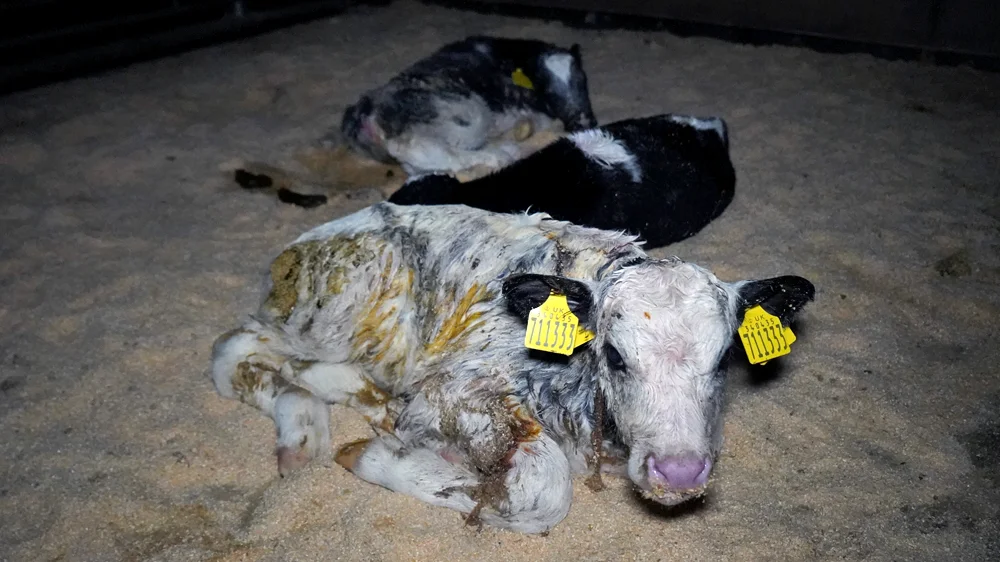
At Longlands Farm in Dorset, Jolene’s calf was ear tagged just 5 minutes after birth and stolen away from her after just 25 minutes. Jolene’s afterbirth was still attached to her as she was sent to the milking parlour. At Marsh Farm, also in Dorset, Daisy watched as her calf, Dee Dee, was wheeled away in a wheelbarrow and dumped in a pen. Daisy was close enough to her calf to be able to see and hear her, but not comfort her. They cried out to one another, tormented by their separation, but unable to do anything about it. The farmers simply went about their day.
Annabelle, at the same farm, gave birth to a stillborn calf. She watched a worker throw her baby into a wheelbarrow and discard them, then paced the barn, bellowing. Almost half an hour later she was chased out towards the milking parlour without a care to her wellbeing.
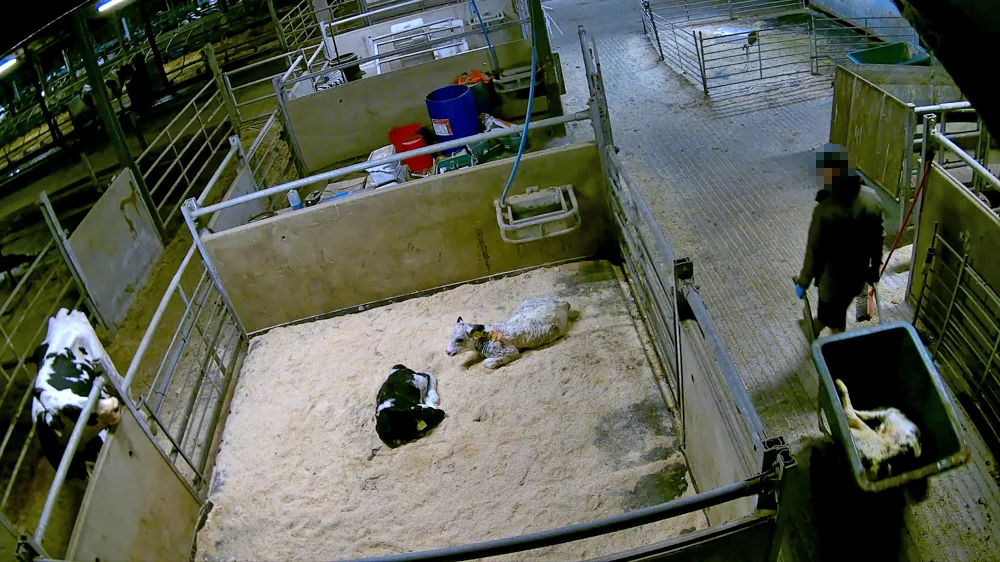
Calves received little compassion from any of the farmers we filmed. They were handled roughly from the moment they were born. At Marsh Farm in Dorset, newborns were dragged by the legs into a wheelbarrow and tipped into pens, and several were force-fed through stomach tubes shortly after birth after not having a chance to bond with their mothers. At Longlands Farm, Dorset, our welfare expert flagged tube feeding as endangering calves, and newborns were lifted by a single hind leg, lowered head-first into trailers, dragged and dropped. Their care was no better afterwards. At Leigh Court, one calf was filmed repeatedly trying to drink from empty water and milk buckets; water was not permanently available. Group pens had heavily soiled, wet bedding, and the neighbouring hutch contained a dead calf. At Marsh Farm, Annabelle’s dead calf lay in a wheelbarrow in the shed for at least three days.
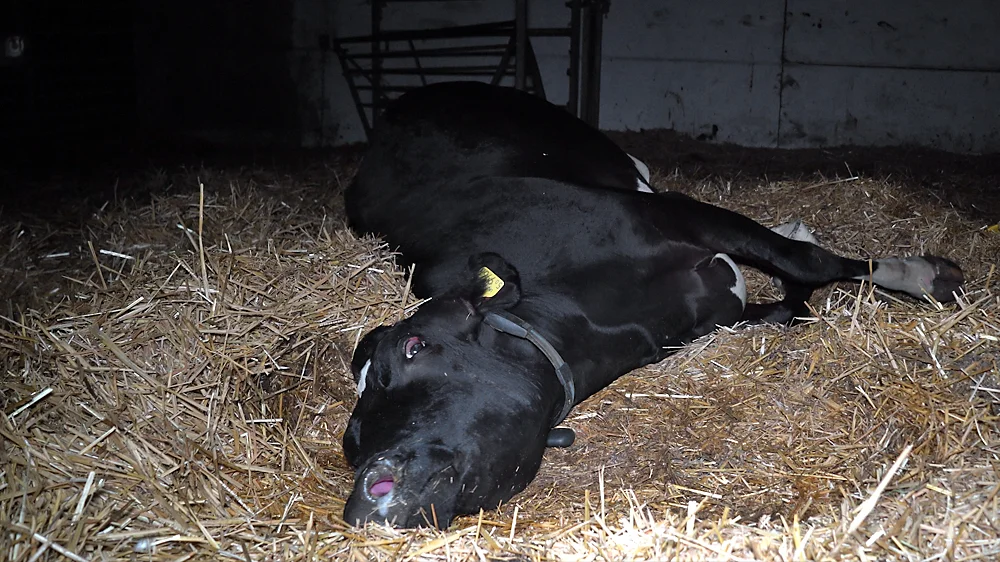
At a second farm called Longlands – a zero-grazing Arla 360 farm – located in Derbyshire, Ella was a ‘downer’ cow, meaning she was so exhausted that she couldn’t stand up or support her own weight. She was moved by a hoist attached to a vehicle and dragged along the ground. The British Cattle Veterinary Association says a hip hoist is meant to lift a cow only, not to move her. She had visible wounds on her hips, knees and ankles, as did other cows in the same pen who seemed to experience a similar distressing ordeal.
“Moving this cow using hip hoists along a concrete floor has caused visible wounds and abrasions to her tuber coxae and her front legs, and the inevitable resulting pain and distress will mean the cow is less likely to stand when she is next lifted. The BCVA guidelines state that ongoing examinations of the cattle should be made throughout treatment to assess prognosis and prevent suffering. This cow does not appear to have been assessed by a vet or farm worker throughout the filming. She frequently has a high respiratory rate, is wide-eyed, lying in lateral recumbency unable to move into sternal, has sunken eyes, and untreated wounds.” – Dr. Molly Vasanthakumar, Veterinarian
We documented five ‘downer’ cows over 10 days. Another cow was dragged using the same hoist and had bloody wounds on her limbs. One lay in the same position for more than 54 hours and others had no water for at least 15 hours. In the same pen, Darcy was beaten, apparently out of frustration that she couldn’t stand, and others were aggressively jabbed with a spanner.
A severely emaciated cow deteriorated during the time we filmed at Longlands Farm. By the last day, she had gone without food for three days and without water for 31 hours. Despite the vet visiting the pen next to where she lay, she appeared to be left to languish. The owner and workers at this farm repeatedly hit the sick animals and even allowed children to do the same. Another cow, this time at Leigh Court in Gloucestershire, was hoisted again and again over two days straight but was still unable to stand afterwards. We don’t know what her fate was or how long her body hung on for.
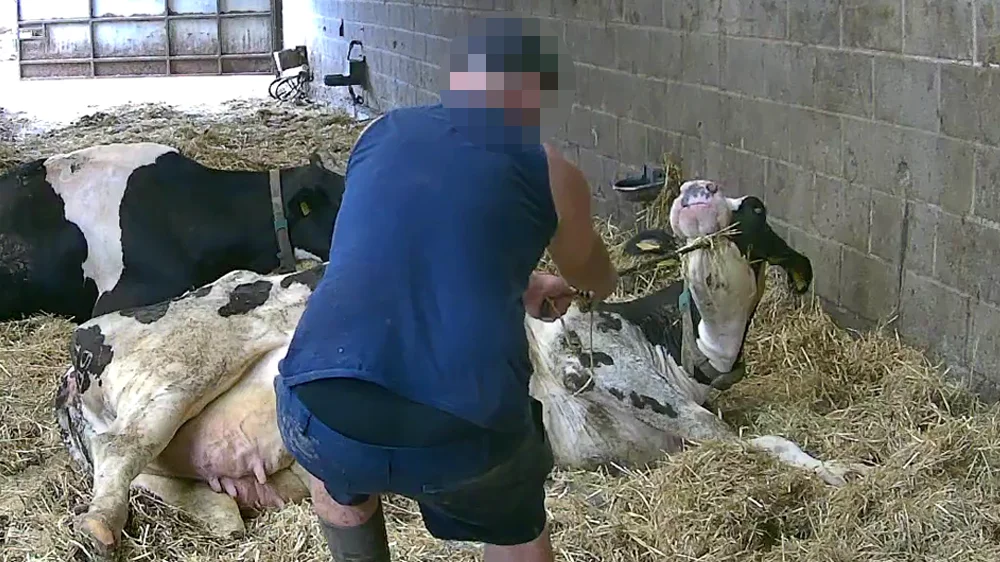
Cows faced episodes of violence from the farmers. It was rarely hidden; cows endured beatings in front of other workers but no one seemed to intervene. Of the 360 breaches across the farms recorded by an independent animal welfare expert, 140 – or 39% – were related to rough handling. At Lower House Farm in Worcestershire, farm owner Doug Roper was filmed yanking tails and slamming a metal gate into a cow as he shouted at them in anger. At Longlands Farm in Dorset, a worker repeatedly slammed a metal bar down onto cows’ backs to get them into the milking parlour.
At Littlewood Farm in Dorset, several workers twisted and pulled tails, kicked cows and struck udders. One blow was so powerful it lifted the cow’s back feet off the ground. Cows were hit with the metal rod of an udder-cleaning device, a quad bike was driven into the backs of their legs, and fingers were forced into a cow’s nostrils to restrain her.
At Bramley Farm in Northamptonshire, during a single minute of footage, a worker kicked a cow twice, struck her on the back and twisted her tail until she cried out in pain. The same worker repeatedly hit another cow with a plastic container, and another after she slipped to her knees. A different worker saw this but did not intervene.
Across all of the farms investigated – independent of if they were Arla CARE, Arlagården or Arla 360 – violence seemed to be the norm. The welfare label never made a difference and nor did the owner’s closeness to the cooperative. George Holmes owns both Littlewood Farm and Longlands Farm in Dorset and he sits on the Arla Foods Board of Directors. David Christensen is the owner of Kingston Hill Farm in Oxfordshire and he is also a member of Arla Foods’ Board of Representatives, chairs Arla’s Policy Advisory Group and sits on the Arla Tesco Committee. It isn’t just one ‘bad apple’, the tree is rotten from its roots. These issues are nationwide and filter right from the top of Arla UK.
But this isn’t just an Arla-specific issue either. Investigations across several large dairy companies in the UK and beyond have revealed systemic abuse being normalised, including at organic farms. Our exposé at Bath Soft Cheese, an organic dairy, revealed the same categories of violations where hitting, kicking and using objects to whack cows was day-to-day normality.
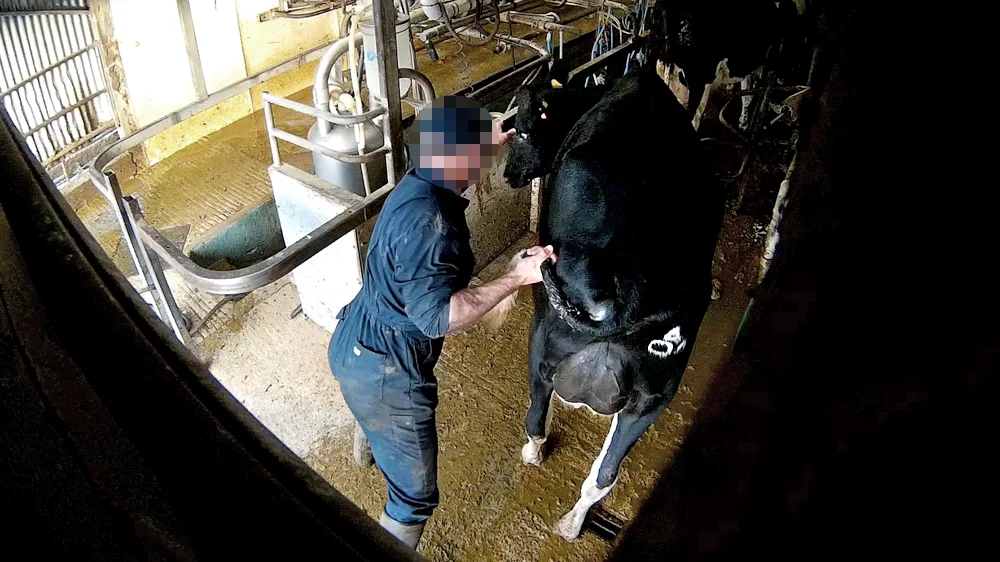
The owner of Oak Lodge Farm in Leicestershire has won industry awards, with judges praising their “very low lameness incidence”. Our welfare expert recorded 25 severe lameness breach cases there, half of all 50 across the ten undercover farms. We filmed more than 20 lame cows in 48 hours, many showing clear signs of pain. Several struggled for up to 30 minutes to get into cubicles, and Polly took almost 25 minutes to step onto a ledge about four inches high. Workers rushed lame cows; only a small number appeared to receive treatment, and automated milking appeared to reduce the routine chances to notice them.
It wasn’t only Oak Lodge. Severe lameness was recorded at six of the ten farms. At Church Farm in Bedfordshire, we identified more than 23 lame cows, at least 15 with obvious difficulty walking, and lame cows were kicked and struck in the crush. At Kingston Hill in Oxfordshire, our expert recorded seven severe lameness breach cases in just eight minutes of footage, including two cows scoring 3 on the AHDB mobility scale, who should have been isolated rather than made to walk. At Marsh Farm in Dorset, a severely lame cow was chased after her calf died, with no treatment seen, and Leigh Court in Gloucestershire recorded five severe cases, alongside clearly overgrown hooves.
Arla says its cows “walk without any problems, and have no pain in their legs or hooves”. It reported that 99.8% of audited farmers had “no major mobility issues” in 2025, but it only counts lameness as a major issue when more than 15% of a herd is lame. In the same year, Arla’s annual report revealed that only 35% of its farms were audited, with the rest of the time relying on self-assessments. How can self-monitoring be accurate and unbiased?
Every June, farmers open their gates to show the public where milk comes from. Last year, more than 200,000 people visited, and AHDB reports that 92% left with greater trust in British food and farming. On 7 June 2026, we visited too. Two of the farms we investigated were open that day: Lower House in Worcestershire, which we filmed in April, and Longlands in Derbyshire, which we filmed in the weeks afterwards.
At Lower House Farm in Worcestershire, an Arla CARE farm, the juxtaposition was apparent.
At the open day: The farmer told visitors, “All we try and do is make sure they have a nice life.” He said calves are separated after “a day, two days” and “neither seems that worried”.
Behind closed doors: In April, we filmed the same farmer yanking cows’ tails after losing his temper, including a cow who had calved only 14 hours earlier. He slammed a metal gate into a cow and struck another repeatedly while shouting abuse, and a worker hit and kicked a lame cow to make her stand, with no apparent intervention. A mother repeatedly tried to return to her calf, who was left crying alone while a worker mocked the calf’s cries.
We saw the same propaganda masking the reality over at Longlands Farm in Derbyshire, after we visited their open day.
On the open day: The farm’s owner told visitors the cows are “a lot happier” with robotic milking and live indoors with “sand beds”, “comfy” and with “a lot of room”. The farm’s vet called it “a very well run farm”. A farmer told visitors, “We love our girls, it’s hard when they go.”
Behind closed doors: In July, we filmed Ella dragged by a hoist attached to a vehicle, and Darcy beaten while she couldn’t stand. An emaciated cow went seven days with no apparent treatment, and others were hit and kicked despite being sick.
At Open Farm Sunday, they show you exactly what they want to show you. The rest remains hidden. Until now.