
.png)




Respect All Life
Will replacing CO₂ with argon end pig suffering?
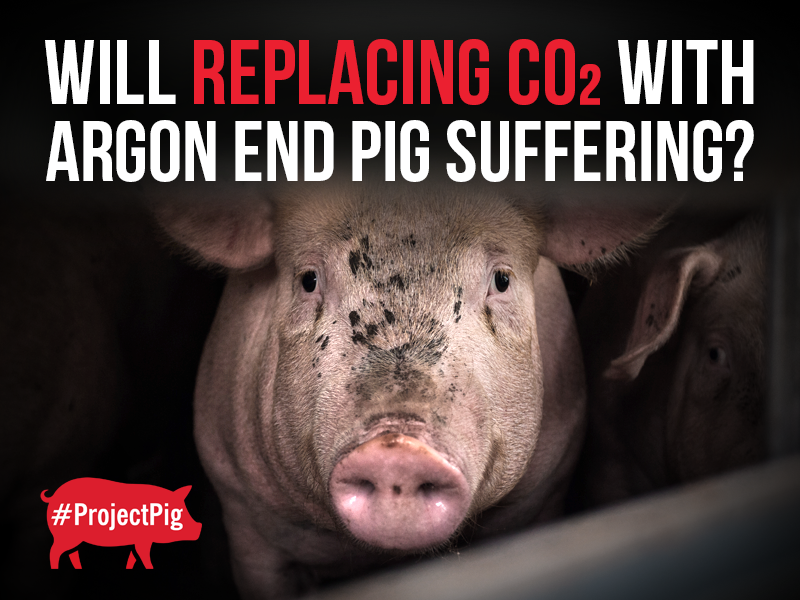
For more than two decades, scientists, veterinarians and animal welfare bodies have raised concerns about the use of high-concentration carbon dioxide (CO₂) gas chambers for pigs. And they have been remarkably consistent: pigs experience pain, fear and respiratory distress before they lose consciousness and die.
In 2025, the Animal Welfare Committee reaffirmed this and proposed a necessary transition to alternative stunning methods within five years.
As pressure grows to phase out CO₂ slaughter, researchers and industry are increasingly looking at alternative gases, particularly argon. But would replacing one gas with another end pig suffering? Animal Justice Project believes the answer is no. No to CO₂. No to argon. No to gas chambers. Because nothing ‘humane’ ever happened inside a gas chamber.
What CO₂ does to pigs, and why scientists are concerned
Today, around 90% of pigs killed in the UK (9 million in total) are put through chambers filled with high concentrations of CO₂ gas. Loss of consciousness is not immediate. During the period before collapse, pigs have been observed gasping, hyperventilating, vocalising, retreating, thrashing, and attempting to escape.
This is likely because CO₂ dissolves in the eyes, nose, mouth, throat, and lungs, forming carbonic acid and causing an intensely unpleasant burning sensation. At the same time, rising carbon dioxide levels trigger breathlessness and feelings of air hunger (EFSA, 2020).
The search for alternatives to carbon dioxide
Between 2022 and 2025, the European PigStun project became one of the largest initiatives to find replacements for high-concentration CO₂, assessing the welfare impacts, economic viability, and implementation challenges of different systems. Among the options considered (such as improved electrical stunning and various gases), argon gas emerged as a top candidate. This is partly because it could be adopted in many slaughterhouses with minimal changes using existing gas chamber infrastructure. However, it has not yet been developed or tested at commercial scale, and PigStun researchers cautioned that further research and implementation are needed.
Is argon the solution?
Argon is an inert (chemically inactive) gas that does not react with other substances and is naturally present in the air we breathe (about 1%). It is industrially ‘harvested’ by cooling atmospheric gas into liquid and separating the component gases. It is being considered as a replacement because, unlike CO₂, argon does not form carbonic acid when inhaled, so it does not trigger the same burning sensations during suffocation.
In one study, researchers tested pigs' willingness to enter environments containing different gases to obtain a food reward. They found that pigs showed no aversion to 90% argon, while most pigs also tolerated lower concentrations of CO₂. However, when exposed to atmospheres containing more than 80% CO₂, the vast majority of pigs chose to avoid this.
Argon also causes pigs to lose consciousness more quickly than CO₂ (13-18 seconds for argon compared with 17- 25 seconds, and in some cases up to 60 seconds, with CO₂). However, argon takes longer to kill pigs (approximately 7 minutes compared to 5 minutes with CO₂). Can 7 minutes of suffocation be considered a humane way for pigs to die?
What about anesthetic gases used for humans? Nitrous oxide (N₂O), also known as laughing gas, has been considered a high-welfare alternative due to its use in human medical settings for pain relief and sedation. While it is relatively cheap and non-flammable, it’s a potent greenhouse gas with an effect 265x that of CO₂. Releasing N₂O at the same scale as industrial animal slaughter would significantly exacerbate the climate breakdown already caused by animal agriculture.
Different gas, same chamber
We support the recommendations to phase out CO₂ slaughter for pigs. However, we believe the debate should not end with finding a better gas. Whatever gas is used, conscious animals are herded into a sealed chamber that runs out of oxygen, and they suffocate to death.
The challenge facing researchers and policymakers is therefore larger than choosing between CO₂ and argon. We should also be asking whether any system designed to kill millions of animals each year can ever be justified as ethical.
While the search for alternatives continues, powerful stakeholders must not use the promise of future welfare improvements to avoid accountability today. The government has a responsibility to set a clear timeline for phasing out gas slaughter, and companies that profit from pig products have a responsibility to acknowledge the suffering associated with gas chambers and to be transparent with consumers about it.
For more information and to take action, check out our Turn Off The Gas campaign.
As always,
For the animals.
.png)


The results of Cranswick's Independent Review are in highlighting 44 major issues.
.webp)
We made a brilliant short film with SPECIESISM.WTF!

We disrupted the UK's biggest animal ag show of the year.
more POSTS
more Press releases






.png)