
.png)




Respect All Life
Choose Kindness this Festive Season
.webp)
- Blog written by Victoria Smith, volunteer blog writer
As we approach Christmas, our thoughts lie with the millions of turkeys who have been bred into existence for the sole purpose of providing a Christmas Dinner centrepiece on tables across the UK and around the world.
These gentle, intelligent birds naturally live around 10 years, but to mark 2025’s religious celebration of hope, love and new life, we’ve slaughtered millions of them, at a mere 3-6 months into their lives.
Turkeys suffer horrendously
Turkeys are curious birds who like to run and explore their environment. Those bred into our food system are crammed into vast sheds in their thousands, where they lack the space to engage in their natural behaviours like foraging and perching – an instinct to be raised out of the danger of ground-dwelling predators.
Industrial breeding practices see turkeys who would naturally weigh around 7.5kg reaching 25kg in just a few months, so farmers can profit from the maximum amount of meat with minimal rearing costs. Growing at this rate is obviously grossly unnatural, and turkeys suffer in the process, from joints that can’t properly support their frames, and lameness and broken legs from being unable to handle the weight placed upon them.
This limitation to mobility even hinders the ability for turkeys to mate, which is obviously an industry requirement, so farm workers will restrain the males, ‘stimulate’ them in a process known as ‘milking’ (a term one can only imagine was put into place to avoid labelling the repulsive process as what it actually is) and then hang the females upside down and artificially inseminate them with the semen they’ve extracted. This process is highly distressing for both sexes, frequently resulting in injury.
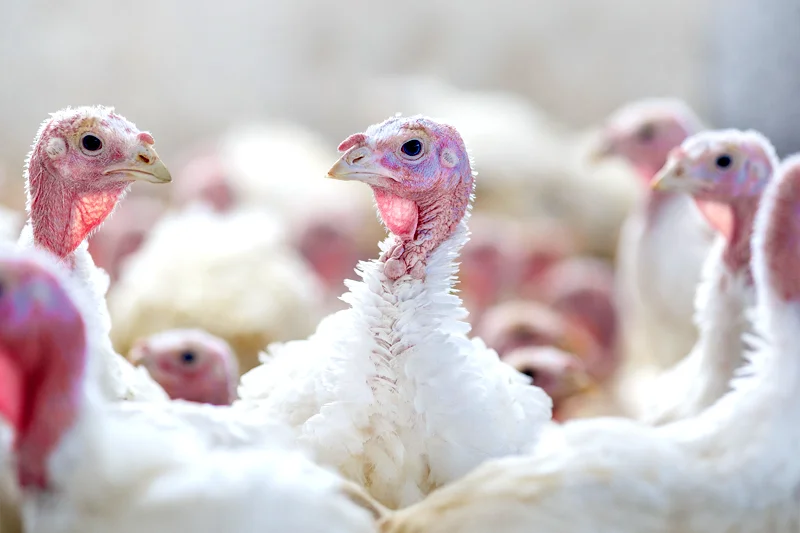
High ‘welfare’ means little for the turkeys
As well as the physical strain of confinement in industrial conditions, turkeys also suffer mentally. In the wild they would live in family groups and form social structures. They’re playful birds and have an array of vocalisations to communicate with each other. But in cramped, unnatural living conditions, they face boredom and frustration and will peck at each other's feathers and eyes. Attempts to curb this include beak trimming when the turkey is a few days old – a practice of blunting the sensitive beak tip so that it’s less sharp and can inflict less damage. This procedure itself, however, can be very painful on sensitive nerve endings and cause lifelong discomfort, as well as hindering the ability to feed.
Once large enough to be profitable, turkeys are roughly transported to slaughterhouses in crates, where they’re either gassed or shackled upside down and moved along a conveyor, where their heads are passed through electrified water baths before their throats are cut and they bleed out. Many are still alive as they’re then dunked into scalding tanks and have their feathers plucked out. Animal Justice Project’s undercover investigation at Pastures Poultry showed that even in ‘high welfare’ operations, this level of pain and suffering is experienced by countless innocent birds.
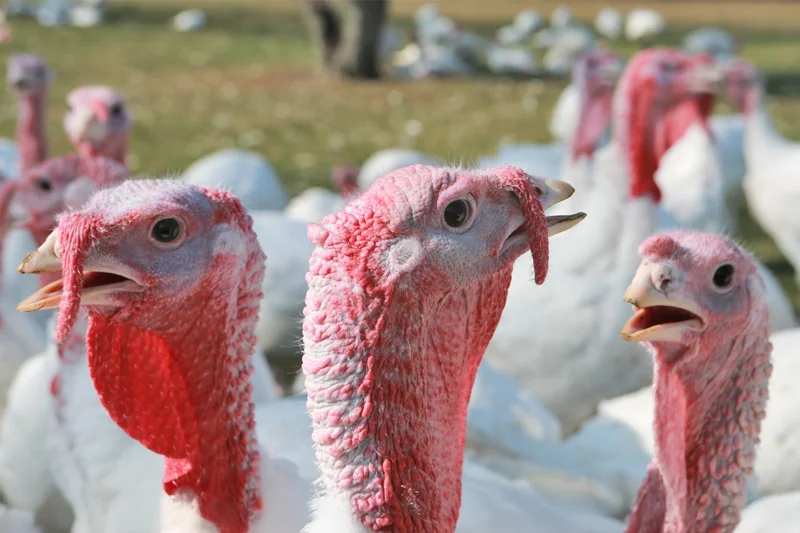
The time for change is now!
By choosing turkey for your Christmas dinner table, you’re directly contributing to the supply-and-demand nature of this industry and perpetuating a completely unnecessary cycle of exploitation and suffering.
There are countless compassionate alternatives that taste delicious and don’t cost another being their life. If you’ve previously enjoyed the taste of turkey but don’t want to fund the practices just described, there are numerous, incredibly realistic substitutes that have been developed exactly for this reason – so you can still have the flavour you’re accustomed to and don’t feel like you’re missing out – you're just skipping the cruelty.
Please choose kindness this festive season. It’s one meal for you, but it’s a turkey’s entire life.
As always,
For the animals.
.png)


The truth about pig farming is concealed behind glossy advertising but what really goes on?
Learn More
Cranswick has lost an entire year of profits as their market value plummeted.

After months of campaigning, the mega-farms have been rejected!
more POSTS
more Press releases




.png)