
.png)




Respect All Life
Why has the government still not banned gas chambers?
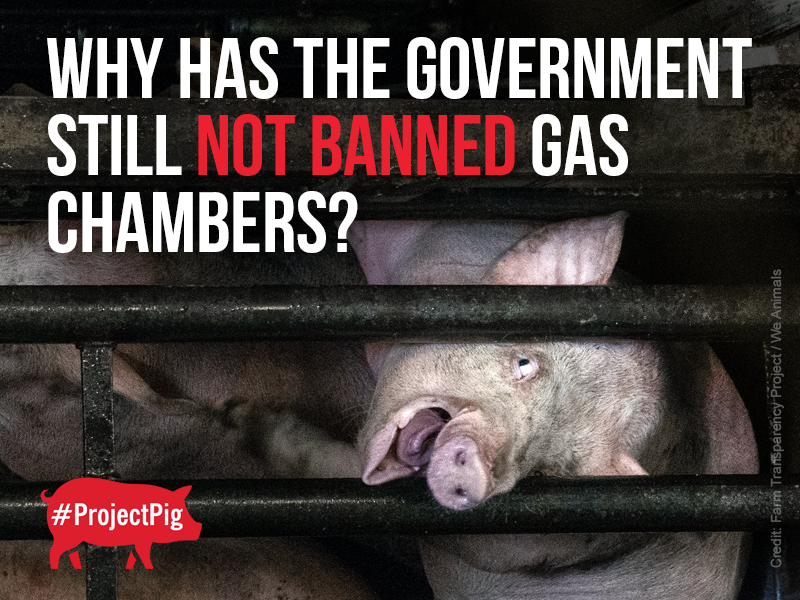
From the early 2000s, CO₂ gassing has steadily risen to the dominant slaughter method for pigs in the UK, killing 90% of pigs (9 million in total) per year.
How do pigs die in CO₂ gas chambers?
A group of pigs is herded into a pen (or gondola) and lowered into a gas chamber. It closes around them, and the chamber is sealed. CO₂ gas is pumped in until the pigs suffocate to death. But they don’t die immediately. At 10 seconds, pigs start sneezing and shaking their heads side to side. By 25 seconds, they’ll be gasping, vocalising, and moving more frantically. For up to 60 seconds, before many lose consciousness, pigs have been recorded retreating, thrashing around, hyperventilating, and attempting to escape (Rodríguez et al., 2023). Exposure to high concentrations of CO₂ causes pain, fear, and distress through severe breathlessness and burning sensations in the eyes, nose, mouth, throat, and chest, as CO₂ dissolves into carbonic acid (EFSA, 2020). A lack of oxygen eventually causes the pigs to become unconscious and die.
A long history of welfare warnings
In 2025, grounded in serious concerns for pigs’ welfare, the Animal Welfare Committee (AWC) recommended phasing out CO₂ slaughter and replacing it with alternative methods within 5 years.
Unfortunately, this is only one recent example in a long history of unanswered calls for change. In 2003, the Farm Animal Welfare Council (FAWC) expressed welfare concerns for the practice and urged the development of alternatives. In 2004, the European Food Safety Authority (EFSA) raised similar concerns, recommending that we stop exposing conscious pigs to high concentrations of CO₂. In 2008, FAWC’s phase-out timeline passed without implementation. By 2013, around 52% of pigs were being killed using CO₂ gas chambers. In 2020, EFSA again positioned CO₂ slaughter as inhumane, identifying it as a proven cause of pain, fear, and respiratory distress for pigs.
As industry and government continued to ignore the evidence, CO₂ gas chambers continued to expand. By 2022, approximately 88% of pigs were being killed using this method, and by 2024, that figure had risen to 90%.
Now is the time for government action
For the first time in over two decades, the phase-out of CO₂ slaughter has moved from a scientific debate into active Government policy. The new Animal Welfare Strategy for Engand (December 2025) finally acknowledged these concerns and announced the intention to consult on banning the practice.
As of May 2026, no consultation has been scheduled. We are calling on the Government to make history by launching a consultation before the end of the year and setting a clear path to phasing out CO₂ slaughter. We also urge the consultation to ask a bigger question: If CO₂ is unacceptable, should gas chambers, death by suffocation, continue at all?
Corporations have great power, but take little responsibility
We are holding Sainsbury’s to account. Not because they are uniquely responsible for CO₂ slaughter, but because they present themselves as a leader in animal welfare while maintaining a major partnership with Cranswick and supporting gas slaughter systems within their supply chain.
As retail power over farming standards and industry practices continues to grow, so too does retail’s responsibility. Sainsbury’s has the leverage to set higher welfare requirements and to drive change across its suppliers, yet it continues to support systems that remain the subject of profound welfare concerns from scientists and the government.
This is why we are calling on Sainsbury’s to (1) publicly acknowledge the concerns associated with gas slaughter that they have previously referred to as ‘the most humane method of slaughter for pigs’ and (2) support mandatory slaughter-method labelling so consumers know own-brand ‘pork’ products come from pigs who were gassed to death.
For more information and to take action, check out our Turn Off The Gas campaign.
As always,
For the animals.
.png)


Animal Justice Project and Speciesism WTF are partnering over the next few months to deliver a set of impactful events.
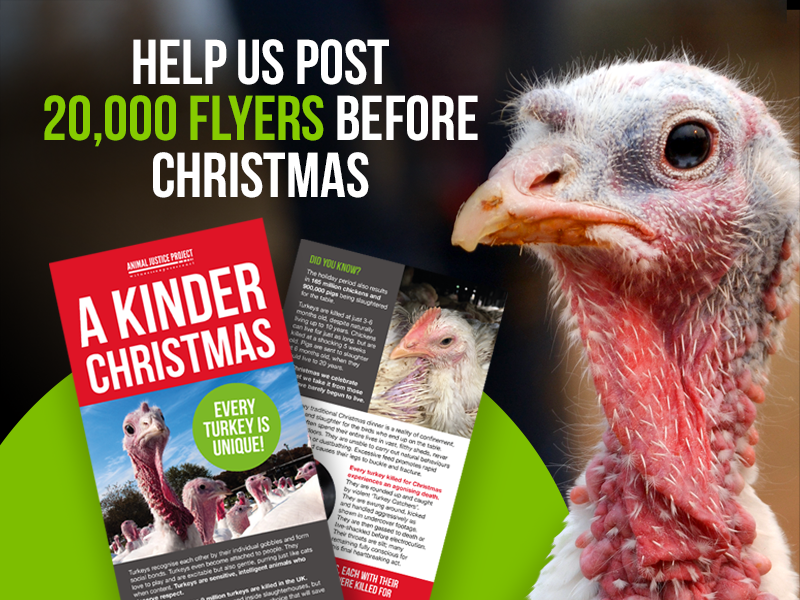
Every flyer is an act of courage. Every doorstep is a chance to inspire change.

The RSPCA's new 'For Every Kind' highlights their hypocrisy.
Learn Moremore POSTS
more Press releases




.png)